Commercial airliner fuselage ejector mechanism concept
My girlfriend was leaving the Czech republic on July 19th 2007, the same day that the terrible Sao Paulo commercial airliner accident happened that killed 200 people. I thought it was a pretty crazy coincidence since commercial airplane crashes are so rare.
Though this probably would not pertain to that particular accident, I've always had an idea for a commercial airline fuselage ejector.
It seems that the majority of passengers seem to parish due to the flammable jet fuel that runs through the aircraft upon impact and current research seems to focus on making the fuel less flammable.
My idea focuses on ejecting the passengers and cargo/baggage away from the dangerous part of the aircraft based on the single engine plane on parachute concept, pictured below.
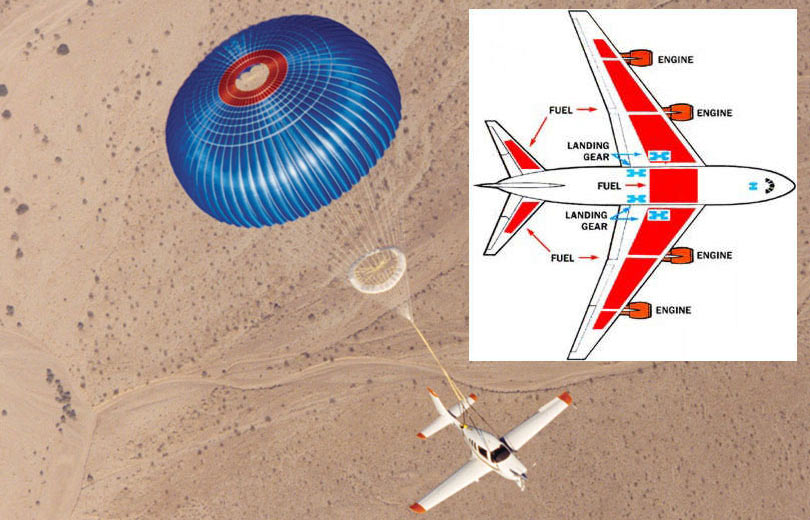
The above picture also shows a diagram of how/where fuel is stored in a commercial airliner.
Below is my concept "animated" in Flash.
1. A routine flight
2. An engine fire erupts! (This could be any malfunction or perhaps even an act of terrorism).
3. The passenger/cargo part of the airplane ejects...
4. Separating itself from the compromised part of the aircraft.
5. Parachutes open and the fuselage lands safely on the ground or in water. There could maybe be inflatables lining the bottom of the ejected portion of the fuselage to act as an impact cushion and/or a flotation device.
Has anyone ever seen this idea or concept before? Please leave a link to any related articles in the comments section. Thanks!
Though this probably would not pertain to that particular accident, I've always had an idea for a commercial airline fuselage ejector.
It seems that the majority of passengers seem to parish due to the flammable jet fuel that runs through the aircraft upon impact and current research seems to focus on making the fuel less flammable.
My idea focuses on ejecting the passengers and cargo/baggage away from the dangerous part of the aircraft based on the single engine plane on parachute concept, pictured below.
The above picture also shows a diagram of how/where fuel is stored in a commercial airliner.
Below is my concept "animated" in Flash.
1. A routine flight
2. An engine fire erupts! (This could be any malfunction or perhaps even an act of terrorism).
3. The passenger/cargo part of the airplane ejects...
4. Separating itself from the compromised part of the aircraft.
5. Parachutes open and the fuselage lands safely on the ground or in water. There could maybe be inflatables lining the bottom of the ejected portion of the fuselage to act as an impact cushion and/or a flotation device.
Has anyone ever seen this idea or concept before? Please leave a link to any related articles in the comments section. Thanks!
16 comments
When you think of all the talk about how safe modern air travel is, you'd almost think that something like this would probably be not be of much use. But then you have to wonder "What if...". I speak for myself when I say I personally would like every and any possible precaution available to me as a customer. If that means eject-able pods with parachutes, then you bet your ass I want it.
I think about how different 9/11 could have been with this system employed. (That is of course not taking the terrorists tactics knowing about this system in to account.)
Would it even have happened at all? United flight 93 could have had a happier ending with this system in place.
I think the parachute physics is trivial. We landed on the moon almost 40 years ago. That fuselage part could be a super composite material. I think if a good pilot had enough time, he could slow the aircraft down enough for it to work.
Your answer gave me another idea too though. Individual parachute pods for every row of seats? Bananas!
This accident in particular comes to mind though... I think it would have worked good in that instance. This clip always brings a tear to my eye... The pilot(s) did so much there. Unreal.
plane crash
-- You couldn't possibly generate enough rocket power to lift that much mass high enough to clear the rear tail structure. This was/is a real problem with single ejector seats on fighter jets. If you are relying on gravity to just drop the fuselage away then you are cutting down the instances where this could work. Think of a plane going straight down.
-- You'd need to reinforce the entire structure to make it survive the acceleration and landing. This would add too much weight.
-- If the explosion or problem is within the cabin area then this idea is moot.
-- Most problems are at low level where no ejection would be possible. Fighter pilots can't eject at very low levels and need big rocket boosts. You'd need HUGE rockets to eject that much mass. Things go wrong so quickly in most accidents you'd likely not have time to react and push the eject button. Who would decide to push that button?
All that said. A method for ejecting just the passenger+seat may be feasible. Some bombers allow the crew to drop down out of the plane rather than boosting them upward. That seems feasible to me. you could put the seats on little rails with motors to shoot them out the bottom of the plane. However, all the structure and baggage area below the cabin would be lost so this probably isn't feasible for an airline interesting in making money.
It's an interesting thing to think about though.
I guess I better stick to my art and leave the engineering to the educated professionals:]
The compromise in the structure of the ship would be an issue for sure.
Keith,
Good answers. Putting rocket ejectors near the fuel compartment does not sound safe for sure. I'm thinking that the tail section would actually be a part of the fuselage and maybe instead of ejecting... The fuselage would slide off to the rear of the plane by motors, could solve the straight down issue. Like the way a battery pops out of a video cam.
Maybe this idea is better suited for film or a video game cinematic but it is fun to walk the line between sci-fi and realism.
I think it would be interesting to hold a "contest" to see what kind of design people could come up with around this concept.
Thanks for participating in the discussion... Later!
Its pretty amazing.
:P
"Statistically speaking flying is still the safest way to travel"
-Superman
Northrop aviation (now Northrop Grumman) tested it on the 60's and the beggining of the 70's.
It was rejected, all the tests ended in complete disaster.
Iread about this about 9-10 years ago, and I don't remember the name of the book. If you want more info there's a page on the ucla website called visions of futer or visions of past future (can't remember) filled with retrofuturistic images. He migth know something
Check out this illustration I've stumbled upon from 1960!
But yes, as someone mentioned, any major explosion caused by a bomb would most likely be inside the cabin, so it wouldn't really matter if you could eject the fuselage from the rest of the airframe (never mind all the structural issues).
Still an entertaining concept.
Nice concept though.